Reading Reflection
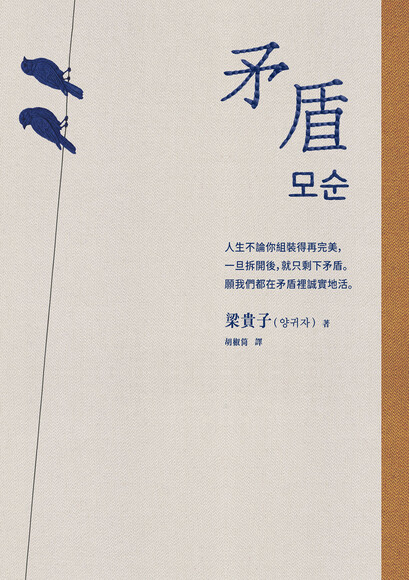
Contradiction
— Yang Gui-ja
Through the protagonist's choice between two very different men, paralleled by the strikingly divergent lives of her identical-twin mother and aunt, the novel weaves a double thread of contradictions—happiness and misfortune, reason and feeling, stability and adventure—seemingly opposite, yet inseparable in life.
Core Content Overview#
Story Summary#
A woman of marriageable age has watched, since childhood, her mother and aunt—identical twins—marry very different men and live very different lives. Now she finds herself standing between two men of her own: one who plans every detail with care, the other spontaneous and full of adventurous spirit.
Written in the first person, the novel uses the identical-twin device to project “one person, two lives”: love and indifference, reason and feeling, happiness and misfortune, stability and adventure. These two-sided contradictions weave together so cleverly that, as you read, you are pulled into your own conflicts and reflections—prompted to think about the choices we make and the diversity of values we live by.
Personal Reflection & Practice#
Happiness and misfortune. Life and death. Spirit and flesh. Abundance and poverty.
The contradictions of life are everywhere. These seemingly opposite ideas are, in our daily lives, often woven together. Choices are not black and white: what looks like the right answer in this moment may, at some point in the future, turn out to have been the wrong one—and what looks wrong now may, in time, prove to have been right.
Lately the idea of “mirrors” keeps circling in my mind—a reflection of another version of myself that I quietly long for. What would I look like if I had taken a path utterly different from the one I’m on? What would I be if I had chosen differently back then? Or if I had never met those events, those people—who would I be now?
It seems we are always drawn to the road we did not take, filling it with curiosity and fantasy. But we cannot walk two utterly different roads at once; we can only choose one. Perhaps the contradictions of life are there to teach us to accept uncertainty, to find balance in the two-sidedness of things and grow within it, and to face our own choices and decisions honestly—whether they bring happiness or misfortune, success or failure, all of it is part of life.
Highlights#
A Passage That Moved Me#
Life is not lived inside the search; we live and search at the same time.
Since life is full of contradictions and uncertainty, we have no way of knowing whether the choice we make today will turn out to be right tomorrow. It reminds me of a striking metaphor:
Life is like driving a car through a moonless night with no streetlights. We can only rely on the headlights to see fifty meters ahead—we cannot predict what waits beyond. Will there be a roadblock? A turn? Or open, level road? We can only act on what is in front of us. And yet we will arrive somewhere in the end—smoothly or with hardship—and that is the journey of life.
Interesting or Unexpected Parts#
If, in everyone’s eyes, the aunt’s seemingly happy life is, to herself, only endless misfortune; and if, in everyone’s eyes, the mother’s seemingly unfortunate life is, to the aunt, happiness—then all that remains is the question of which form of misfortune and happiness to choose.
Perhaps what we see as happiness, others see as suffering; and what we see as misfortune, others see as joy. The contradiction of life lies in this: we cannot be certain which choice is the right one, because every person’s values, experiences, and expectations are different. We can only choose by what feels true to our own inner sense and values, and accept whatever consequences follow.
Extended Thinking#
All my life I have lived smoothly, and after marriage even more so—comfort, plenty, wanting for nothing. And yet such a flawless life is exactly what has shattered me.
That is precisely why I want to end it.
What kind of life truly counts as a happy one? One that is settled and smooth, or one full of risk and challenge? Can we find our own point of balance among these seemingly contradictory choices? And could the contradictions themselves be a chance for growth—teaching us to accept uncertainty, and to find within it our own meaning and worth?
Recommendations & Summary#
Suitable Readers: Readers who want to learn how to find balance amid contradictions.
Summary:
Yang Gui-ja unfolds contradiction along a double structure: on one side, the lives of identical-twin mother and aunt are placed before the reader as “one person, two lives”; on the other, the protagonist herself stands between two men of utterly different temperaments and must, with her own hand, decide. These seemingly opposing choices are not black-and-white opposites; they are more like two faces that bleed into and reflect one another—happiness already carrying the seeds of misfortune, stability hiding a longing for adventure—visible only depending on the moment, and the eyes that look.
After finishing this book, I did not come away with any answer about “how to choose.” Instead, I became more willing to accept that life cannot be fully rehearsed: every choice in the present means letting go of another possibility. But that is not a loss to mourn. We don’t set out only after seeing the whole picture—we walk, and the road takes shape as we go. Perhaps maturity is learning to stop clinging to “the self on the other path,” and instead face, honestly, every turn on this one.