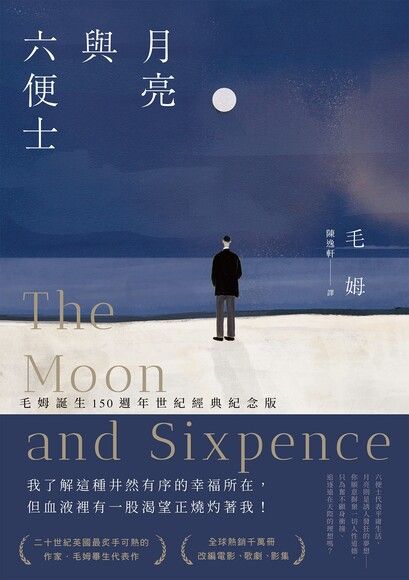
Reading Reflection
The Moon and Sixpence
— W. Somerset Maugham
Through an extreme figure who abandons everything to chase artistic ideals, reflecting on the lines I would—and would never—cross between ideals and reality.
A note before reading: This book was first published in 1919, when post–WWI Britain was transitioning from a rigid patriarchal structure toward a more equal society. The text occasionally carries a male-chauvinist tone in its word choice—you can choose to focus on the story behind it, while also being aware that some of this phrasing may be deliberate. Read it as you see fit.
Core Content Overview#
Story Summary#
The book uses the moon to symbolize ideals and sixpence to represent reality. It tells the story of a man who once held a well-paid job and social standing, but who abandons everything to throw himself into artistic creation.
Fearlessly chasing his inner ideal, he is unshackled by worldly opinion and undeterred by harsh surroundings or illness. All he needs are canvas and paint. He eventually produces works of extraordinary power—yet is willing to burn them without hesitation. The surviving pieces go on to become treasured classics admired by later generations.
However, the author does not paint him as an idealist hero. He abandons his wife and children, intrudes into another man’s marriage purely to satisfy desire, and shows no remorse even after indirectly causing a death. He regards social norms and morality as nothing, gradually severing every human tie—ignoring others, and ignoring himself—until only the rawest creative impulse remains. He ends his days poor and dying, alone in a foreign land.
Highlights#
Below are a few characters who left a strong impression on me.
Dirk Stroeve
He looked around for his hat. Then she said: “Dirk, I am going away with Strickland. I can’t stay with you any longer.”
“I wanted to speak, but the words wouldn’t come. Strickland said nothing. He went on whistling, as if it were none of his concern.”
“I love her much more than myself. It seems to me that when vanity enters into love it’s because you love yourself better than the one you love.”
“Love is intoxicating; it makes the lover forget himself entirely. Even the sharpest, clearest mind—though it may know—cannot understand that its own love will end. He knows the love is an illusion, yet love gives that illusion substance; and even knowing it for an illusion, he loves it more than the truth.”
As the representative of ordinary, grounded humanity, Dirk almost worships Strickland’s artistic genius. Even when he is baffled and repelled by Strickland’s behavior, he cannot let go of that admiration. What I find most puzzling, however, is his near-total self-erasure in love—giving everything for it, and continuing to give without complaint even after being betrayed and wounded. I find that pitiful.
I see him as the most humble sacrificial figure in the book: in giving of himself to the point of losing the self, he also lost his own soul.
As for love, I believe in offering complete trust—my partner is free to go out, to enjoy life—but in return I expect absolute faithfulness. That is the most important thing to me. If one day you decide to leave, or you can no longer uphold the commitment of loyalty between us, please tell me honestly. No arguing, no pleading. I will respect your choice and walk away without hesitation. Once loyalty is gone, everything else loses its meaning.
Blanche (Mrs. Stroeve)
“A woman can forgive a man for the harm he does her, but she can never forgive him for the sacrifices he makes on her account.”
She must have been very unhappy, but the blindness of love made her believe whatever she wished to be true. And her love was so strong that she could not believe it would not awaken an equal response.
Originally a governess in a wealthy household, she had an affair with the young master of the house, became pregnant, and was cast aside—driven nearly to suicide. Stroeve appeared at her lowest moment, offering comfort and support, and they eventually married. His love for her was selfless, willing to sacrifice himself for her happiness. I don’t quite believe that Blanche never loved Stroeve at all; but the sacrifices and devotion she received may have felt to her more like a burden of guilt.
Strickland’s arrival awakened her most primal desire, and she resolutely followed him away. But to Strickland, she was merely an outlet for appetite. Perhaps what she chased was never Strickland’s love, but her own inner belief in an all-consuming passion—and that belief ultimately turned her into a martyr.
Strickland
The passion that held Strickland was a passion to create beauty. It gave him no peace. It urged him hither and thither. He was eternally a pilgrim, haunted by a divine nostalgia, and the demon within him was ruthless. There are men whose desire for truth is so great that to attain it they will shatter the very foundation of their world. Of such was Strickland, only beauty took the place of truth with him.
And yet, though I was confused and unsettled, I was moved. Even to my ignorant eye, I could not help feeling that this struggle for self-expression was a true and genuine force.
He could never endure any outward restraint. Though it might pain him, though it might leave him bruised and bleeding, if anything came between him and that nameless longing that drove him on, I believe he had it in him to tear it out of his very heart by the roots.
He shook his head, smiling.
“Had she done anything to deserve it?”
“No.”
“Had you any complaint to make against her?”
“No.”
“Then isn’t it monstrous to leave her like this, after seventeen years of marriage, without a fault to find with her?”
“Monstrous.”
This exchange lays bare his determination to cast everything aside for his ideal—indifferent to betrayal, unrepentant for the damage he inflicts, blind to the feelings and consequences he leaves behind. It is extreme self-centeredness, and at the same time an almost obsessive devotion to art.
Interesting or Unexpected Parts#
“Do you mean to say that if he left you for a woman you’d forgive him, but if he left you for an idea you wouldn’t? You think you’re a match for the one, but against the other you’re helpless?”
Now I know very well that pettiness and grandeur, malice and charity, hatred and love, can dwell side by side in the same human heart.
“You know, I think you must be mistaken in supposing Charles is alone. From what I’ve heard—from sources I can’t reveal—he did not leave England by himself.”
“In that case he has a remarkable talent for covering his tracks.”
She flushed slightly and looked away.
“What I mean to say is, if anyone should speak to you about it, and they say he has run away with someone, please don’t contradict them.”
“Of course not.”
This passage comes from Strickland’s original wife. She already knew perfectly well that Strickland had left alone to chase his ideal, yet she claimed publicly that he had run off with another woman—using the lie to mask the humiliation of being abandoned, while drawing sympathy and tangible benefit from it. In later years, she even enjoyed all the perks of being the widow of a famous painter.
Passages That Moved Me#
“The heart has its reasons that reason knows nothing of.”
“People talk of beauty lightly, and having no feeling for words, they use that one carelessly, so that it loses its force; and the thing it stands for, sharing its name with a hundred trivial objects, is deprived of dignity.”
“Beauty is the most precious thing in the world. How could you believe that it would lie about on the seashore like a stone for any passer-by to pick up idly? Beauty is wonderful and strange, forged by the artist’s soul in anguish out of the chaos of the world. And when it is made, not everyone recognizes it. You must walk the artist’s road of struggle to see it. It is a melody he has sung to you, and to hear it again within your own mind you must have the knowledge, the sensitivity, and the imagination.”
Personal Reflection & Practice#
By choosing such an extreme—at times unacceptable—figure as his subject, the author pushes us to reflect: on the road to self-actualization, how far can we go, or should we go, to strike a balance between our ideals and our reality without betraying ourselves?
While reading, some passages left me uncomfortable and indignant—I thought Strickland was selfish, cold, and cruel. But others stirred me with his passion and devotion to art; I even sensed his loneliness and suffering. That contradictory feeling reminded me: in our own pursuit of ideals, we face similar tensions.
If chasing an ideal meant abandoning family and friends, betraying love, or hurting others—those, for me, are lines I cannot cross. They are where my values hold firm, and where my most basic respect for others lives.
This book gave me a clearer sense of where the line runs between ideal and reality, and a deeper thought on how to hold the balance between them.
Recommendations & Summary#
Suitable Readers:
Readers weighing how to choose between ideal and reality, those drawn to the complexity of human nature, and anyone who likes reflecting on their own values through literature.
Summary:
Maugham offers no answer. He simply places an extreme man in front of you and lets you feel your way through—admiration, revulsion, sympathy, bewilderment—all of which can coexist. The value of this book isn’t in telling you how to live; it’s in forcing you to face one honest question: between ideal and reality, where exactly does your line fall?